Showing posts with label wifi. Show all posts

Monday, 11 June 2007

Wi-Fi enabled SD cards coming to a camera near you


While digital cameras with Wi-Fi built in haven't exactly taken off, it makes sense in this ever-more wireless world that Wi-Fi will become a standard means of connecting a digital camera, eventually. However, Eye-Fi have come up with a solution which might be a bit nearer off and save you the trouble of updating your camera yet again. They plan to incorporate a Wi-Fi chip directly onto the standard SD card format, so you would get storage and connectivity in one. However in addition to easily sending photos to your personal computer you'll also be able to share photos instantly with online photo and social networking sites.

Monday, 12 February 2007

New phones galore

A bevy of new mobiles were released today at 3GSM 2007, the world’s biggest mobile telecommunications conference, in Barcelona. Among the highlights were new handsets from RIM, Nokia, Samsung and LG. Some pics and quick details below.

BlackBerry 8800

The Pearl's big brother (above), sporting a full QWERTY keyboard, GPS receiver to work with a mapping service, microSD slot, bluetooth 2.0, the usual email stuff and the now de rigeur 'pearl' trackball. And it's only 14mm thick.

Nokia E61i, E65, E90 and N77

Nokia released 3 new business focused phones (above): the E61i, their answer to the BlackBerry; the E65, a smaller, more stylish, slider phone and the E90, an old-style communicator flip phone. The E61i now packs a 2 megapixel camera and both it and the E90 feature 3G and WiFi.

The N77 (above) is a consumer phone which features a 2.4 inch screen, stereo speakers and the ability to pick up mobile TV broadcasts over DVB-H - a special digital TV format for viewing on mobile devices.

Samsung Ultra Edition II

Announcing a a whole new range of ultra-slim phones, ranging from 5.9-12.1mm thick, Samsung stole the show. The U100 (above) is the thinnest phone in the world at 5.9mm. Amazingly it features a 3 megapixel camera, bluetooth and 70MB of memory!

LG Prada


LG's pre-emptive, touch-screen strike against the iPhone. It's 12mm thick and features a 2 megapixel camera. Very slick and very expensive.

Wednesday, 10 January 2007

Apple TV and other Macworld news

OK, so the iPhone wasn't the only thing Apple announced yesterday but it was all I had time to cover! So here's the other stuff.

Apple TV

As expected, the second major product launch was Apple TV (formerly iTV), the set-top box of tricks for streaming and storing iTunes content from your Mac or PC for playback on your TV.

The details are much the same as reported last year but just to recap, it's a slim, set-top box with a 40GB hard drive, 802.11 b/g/n WiFi, ethernet, HDMI, component and optical output, USB 2.0 and an included Apple remote.


It supports output for either high or enhanced definition TVs in 1080i 60/50Hz, 720p 60/50Hz, 576p 50Hz (PAL format), or 480p 60Hz.

It works pretty much like an iPod in that it syncs with iTunes but it does so automatically across your wireless (or wired) network. So if you download a new album, podcast, TV show or movie on your Mac, or upload a new photo album from your camera, it will all automatically sync to your Apple TV ready for viewing on your big screen TV.


It uses the latest draft 802.11 'n' specification wireless technology but is also backwards compatible with the older 'b' and 'g' 802.11 varieties. With the extra speed of the new 'n' WiFi it can also stream video directly from your computer without having synced it first.

It syncs with up to 5 computers (even visiting friends' computers!) and sets itself up pretty much automatically with minimal configuration needed from you.

It definitely looks pretty cool and I would find it useful as I use EyeTV to record Freeview programs quite a bit, so I can use this as an easy way of watching that recorded content on my TV without having to burn it to disk (although it will mean exporting it to iTunes first).

Airport Extreme

To go hand-in-hand with the Apple TV and enable you to take full advantage of its new draft 802.11 'n' specification wireless, Apple also announced an all-new Airport Extreme base station. The new spec offers up to five times the performance and up to twice the range of networks created with the earlier 802.11 'g' standard.


It turns out all the latest Core 2 Macs have been shipping with 'n' spec wireless cards, so you'll be able to take advantage of that extra speed across your whole network if you are lucky enough to have recently bought one.

Connect almost any external hard drive to the USB port on the back of your AirPort Extreme and AirPort Disk turns it into a shared network drive. Anything on the drive instantly becomes available to anyone on your network, Mac and PC alike. The same USB port also allows you to share a printer throughout the network.

Apple, Inc

As if confirming their increasingly clear consumer electronics strategy Apple Computer, Inc is no more. Steve Jobs announced at the keynote that the company is to be known simply as Apple, Inc from now on.

It seems to make complete sense, they haven't been just a 'computer' company for quite some time now. After the announcements of the last couple of days, if I were an executive at Samsung, Sony or Philips I would be quite worried. Apple is coming.

Tuesday, 9 January 2007

Apple announces incredible iPhone

Apple announced the iPhone today at Macworld San Francisco. A clearly excited Steve Jobs introduced the device to a standing ovation and astonishment from the crowd.

In some ways 'iPhone' is not an apt description of the multi-functional device at all. Apple describes it as "a revolutionary mobile phone, a widescreen iPod with touch controls, and a breakthrough Internet communications device with desktop-class email, web browsing, maps, and searching - into one small and lightweight handheld device."

"iPhone also introduces an entirely new user interface based on a large multi-touch display and pioneering new software, letting you control everything with just your fingers. So it ushers in an era of software power and sophistication never before seen in a mobile device, completely redefining what you can do on a mobile phone."


iPod

iPhone uses iTunes to sync with your Mac or PC in just the same way as an iPod so all your music, audiobooks, videos, TV shows and movies can be enjoyed on the 3.5 -inch widescreen display.

Mobile phone

iPhone allows you to make calls by simply pointing your finger at a name or number in your address book and it will automatically sync all your contacts from a PC, Mac, or internet service such as Yahoo! or Gmail. It also introduces a new 'Visual Voicemail' feature that allows you to go directly to individual voicemail messages without having to listen to them in order, just like email.

SMS messaging is handled using an on-screen software keyboard with predictive input and error correction. The interface is very iChat like and is more like sending instant messages than text messages.

It also features an integrated 2-megapixel camera and iPhoto-like photo management software that is far more sophisticated than current mobile phones.

Internet communications

iPhone features a rich HTML email client that can fetch or be pushed your IMAP or POP3 email in the background and a mobile version of Safari which is the most advanced web browser ever on a portable device. It automatically syncs bookmarks from your PC or Mac and includes built-in Google and Yahoo! searching. It's fully multi-tasking, so you can read a web page while downloading your email in the background over WiFi or EDGE.

The iPhone's Maps application integrates with Google Maps to offer map, satellite and local information, all controlled with the touch screen interface enabling you to easily move around and zoom in or out.

The iPhone also borrows Widgets from OS X to give you quick access to weather, stocks and other data in real-time through the internet.

Technology

It's a pretty incredible device and has to be seen to be fully appreciated. The multi-touch screen and OS X operating system looks extremely intuitive and well thought out with the rich HTML email, full-featured web browsing, and desktop-class applications such as widgets, Safari, calendar, text messaging, Notes, and Address Book.

The iPhone is also well connected with quad-band GSM, EDGE, 802.11b/g WiFi and Bluetooth 2.0.

To top it all off, the iPhone can sense when you rotate it from portrait to landscape and automatically changes the contents of the display, so you immediately see the entire width of a web page or a photo in its proper landscape aspect ratio.

A proximity sensor detects when you lift iPhone to your ear and immediately turns off the display to save power and prevent inadvertent touches until it's moved away. And an ambient light sensor automatically adjusts the display’s brightness to the appropriate level for the current light level, enhancing the user experience and saving power at the same time.

Conclusion

iPhone shifts the landscape of the mobile industry just as the original Mac did for home computing and the iPod did to the music industry. I honestly think it's that significant.

Steve Jobs said during the speech that it's "5 years ahead" of anything else and I think he's right. The seeming simplicity and ease of use sets a new standard for mobile operating systems, like only Apple could, and belies the complexity and breadth of features beneath.

My only real concerns are with the absence of any 3G connection for high-speed data when not in reach of a WiFi network and the relatively limited 4 or 8GB storage capacity.

3G and a second camera on the face of the iPhone would allow for video calling and could also be integrated with iChat for VoIP video calling, which would be truly awesome.

8GB of storage worries me as well. My nano has 8GB and that is not enough to get my music library on, let alone all my email, photos and video! I would have expected more like 16GB to make the device capable of holding a decent amount of content or at least some kind of memory expansion via SD or something. On the other hand, for a mobile phone, 8GB is way more than the average device.

Overall though, this is an absolutely stunning product. Just reading the transcript of the keynote as it was taking place, I was completely gob-smacked at what Apple have managed to achieve with the iPhone. It's up there with even the most fervent rumours but now it's a reality.

It's much more than just a mobile phone with music playing features, it's a Mac in your pocket.

To see the iPhone in action make sure you head over to the Apple site and watch the QuickTime demos. It really will amaze you.

CES roundup

The Consumer Electronics Show (CES) is under way in Las Vegas this week and there has been a deluge of new products announced from all the major manufacturers.

A lot of them are not that interesting or significant (to me anyway), so I'm going to try and cut through the crap and highlight here some of the things that interest me and hopefully you.

Xbox 360 IPTV

Microsoft kicked of proceedings with their keynote, of which the most interesting thing to come out was the announcement that in late 2007 they will be offering TV over your internet connection direct to your Xbox 360. They gave a demo at the keynote and there are some screen shots and a video about as well.

It does look quite cool and allows you to do Sky+ type things as well as some intriguing ideas such as recording a TV program in the background while playing a game in Xbox Live! Could be interesting competition to Apple's forthcoming "iTV" as well.

Microsoft really do appear to be trying to cram everything they can into the 360. They also announced that they have shipped just over 10 million 360s to date.

Samsung Blu-Ray player and 1080p TVs

Samsung announced the BD-P1200, their second generation Blu-Ray player. It's slimmer, cheaper and better specified than the previous BD-P100 and should be hitting the US in June.


Samsung also announced 3 new 1080p LCD TVs in 40, 46 and 52 inch varieties featuring 3 HDMI 1.3 ports, 12,000:1 contrast ratio and 1920x1080 resolution among other things.


Pioneer A/V receivers

You're gonna need some sounds to go with your new TV and Blu-Ray player, so how about one the of the four new monster Pioneer receivers: VSX-517, VSX-817, VSX-917V, and VSX-1017TXV (pictured).


Featuring satellite radio (big in the states), iPod integration, 120Watts over each of the 7 channel outputs and THX Select 2 certification for the top of the range beast.

Toshiba REGZA LCD TVs

Four new 720p LCDs in 26, 32, 37 and 42-inch screen sizes and updates to the 42, 46, 52 and 57-inch 1080p Cinema Series, which include 120Hz anti-motion blur technology, ethernet port and HDMI 1.3 connectors with Deep Color and xvYCC support. They also found the time to introduce two new 26 and 32-inch models that include a built in DVD player!

Philips wireless HDMI

Hate that clutter of wires behind your TV? Everything seems to be going wireless these days and HDMI is no exception with Philips announcing a new solution with enough bandwidth to send an uncompressed HD stream of up to 1080p resolution. It's based on an ultra wide band frequency so shouldn't interfere with other wireless stuff like your WiFi network or DECT home phone.

Sharp's new Aquos TVs

Sharp announced 4 new lines of TVs, from the top of the range, 8th Generation 1080p capable D92-Series to the more affordable 720p capable D43-Series with others in between. The D92s feature 15,000:1 dynamic contrast ratio, 4ms response time, 120hz refresh rate and 3 HDMI ports.


New Panasonic plasmas

Last but not least, Panasonic announced a new 42" prototype 1080p plasma, possibly the holy grail as far as I'm concerned, as well as new 50, 58, 65 and 103-inch plasmas. Also new HD camcorders, Blu-Ray and home theatre stuff.


Phew, that's about it. Now, get ready for the Steve Jobs keynote at Macworld tonight, it looks like it's gonna be a big one.

Tuesday, 26 September 2006

Compact digital camera roundup

People ask me all the time "Which camera should I buy?", by which they are normally referring to a point and shoot digital compact.

Over the summer there have been new compacts announced by pretty much all of the major manufacturers, so here's a summary of some of the best and a quick feature comparison.

I hasten to add, I haven't used any of these cameras, so make sure you read some proper reviews before making any purchasing decisions!

I've selected the newest, most comparable offerings from each manufacturer, so these are really the high-end of the ultra-compacts with the latest features, not your budget cameras.

So, here they are, in alphabetical order:

Canon Digital IXUS 850 IS
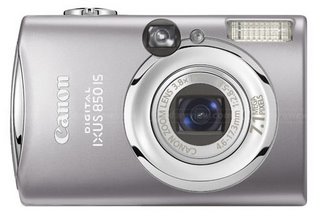

  • 7.1 megapixels
  • 2.5" LCD
  • 25.1mm thick
  • 640 x 480 @ 30 / 15fps movie mode
  • ISO 1600
  • 3.8x optical zoom
  • Face Detection / 9-point focus
  • SD / SDHC / MMC memory cards
  • Optical image stabilisation
  • Approx. 270 shots on one charge

Casio EXILIM Card EX S-770
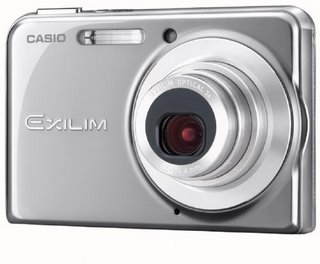

  • 7.2 megapixels
  • 2.8" widescreen LCD
  • 17.3mm thick
  • 704 x 384 (Wide), 640 x 480 movie mode
  • ISO 800 (Anti Shake or High Sensitivity modes)
  • 3x optical zoom
  • 9 point multi focus
  • SD / SDHC / MMC memory cards
  • Anti-shake DSP
  • Approx. 200 shots on one charge

Nikon Coolpix S7c
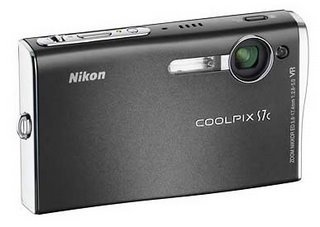

  • 7.1 megapixels
  • 3.0" LCD
  • 21mm thick
  • 640 x 480 @ 30fps movie mode
  • ISO 1600
  • 3x optical zoom
  • Face-priority AF focus
  • SD memory cards
  • Vibration Reduction
  • WiFi connection
  • Approx. 200 shots on one charge

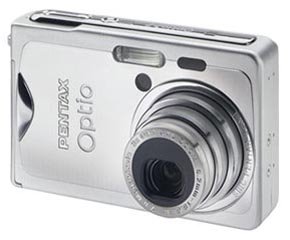
Pentax Optio S7


  • 7.0 megapixels
  • 2.5" LCD
  • 19.5mm thick
  • 640 x 480 @ 30 fps (DiVX) movie mode
  • ISO 400 (800/1600 at 4 MP)
  • 3x optical zoom
  • 5-point multi focus
  • SD / SDHC / MMC memory cards
  • Blur reduction mode
  • Approx. 180 shots on one charge

Sony CyberShot DSC-T10
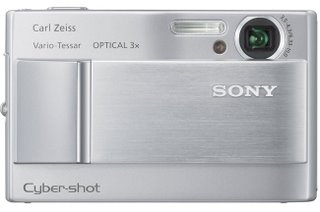

  • 7.2 megapixels
  • 2.5" LCD
  • 20.6 thick
  • 640 x 480 @ 30fps movie mode
  • ISO 1000
  • 3x optical zoom
  • 5-point multi focus
  • Memory Stick Duo™ / Memory Stick Duo™ Pro memory cards
  • Optical image stabilisation
  • Approx. 250 shots on one charge

Comparison table

(click image for large, readable version!)


So, all of the cameras have about the same resolution sensors; similar sized, decently large screens; similar movie modes and at least some kind of anti-shake or blur reduction.

I think table shows that spec-wise the Canon is the leader with it's high ISO 1600 sensitivity, optical image stabilisation, 3.8x zoom, face detection auto-focus and 270 shots on one charge. However, it does sacrifice on it's size and weight and is the most chunky of the 5.

The smallest is the Casio at just 17mm thick, nearly 8mm thinner than the Canon, while still managing to pack a 2.8" 16:9 display (the only widescreen display amongst this bunch), a 3x zoom, the same resolution and good battery life. It also has a widescreen movie recording mode. Very impressive and if having the most ultra-compact camera is what you're after, this is the one.

The Nikon has the largest screen at 3" and is the only camera here with WiFi for transferring images to your computer or printer wirelessly (although that may be frustratingly slow when downloading a whole memory card). It also has the same high ISO 1600 sensitivity and face recognition auto-focus as the Canon but it is also the second thickest after the Canon and doesn't support the new SDHC memory card format.

The Pentax doesn't really best any of the others in any category but it isn't too far off in most areas. It's the second thinnest after the Casio but it has the worst battery life at only 180 shots and only manages 4 megapixels at it's high sensitivity setting (7 megapixels normally). Otherwise, it's pretty much in line with the others with the 2.5" LCD, 3x zoom and 640 x 480 30fps movie mode.

Finally, the Sony is similar to the Pentax but slightly thicker, it does though have the second best battery life and is the only one here, other than the Canon, to have proper optical image stabilisation. But one of my pet hates about Sony is their insistence on using their own memory card format. All the other cameras here use SD but the Sony uses Memory Stick Duo, so if you already have SD cards, you're going to have to buy all new Memory Stick Duo cards to use the Sony.

So, which one would I buy? In the absence of hands-on reviews, judging purely on the specs and what I know of previous cameras from these manufacturers, I would say if you don't mind the extra bit of bulk, the Canon will probably take the best pictures but if smaller is better, then the Casio could well be the one. I would also consider the Nikon as it's possibly the best all round compromise between features and size.

I definitely recommend you try and find some decent reviews of these cameras before buying one though and as always, go into Jessops or something, have a look and try them out as well.

dpreview.com is always a good place to find excellent reviews.

Friday, 22 September 2006

Sony drop PS3 price by 20% and include HDMI 1.3

Finally, some good news from Sony. They just announced today that they are cutting the launch price of the 20GB version of the PS3 in Japan by about 20% to ¥49,980. They have stated so far that this is a Japan only price drop and the US and Europe pricing remains unchanged.

Not only that but the 20GB, lower-end version of the PS3 now includes an HDMI 1.3 output (the latest spec), which was the other major sticking point that so many people were unhappy about.

So what does all this mean? Well, I think it absolutely proves Sony's strategy was wrong on the PS3 from the beginning by making it so expensive relative to the Xbox 360 and Wii and not including an HDMI output on the low-end model to enjoy all of the much-hyped Blu-ray content in full-on 1080p digital clarity.

I think Sony must have realised what a mess they'd made and, fair play to them, have corrected the mistake before launch. They are probably petrified about the competition from the much cheaper Wii in Japan specifically and the Xbox 360 with HD-DVD add on in the US and Europe. They had to do something and in fairness this does seem like a good move.

I think it certainly makes the 20GB much more attractive and it now begs the question of why you really need the more expensive 60GB version, just for the sake of WiFi, a larger hard drive and a memory card reader?

The next-gen console wars aren't over yet.

Thursday, 21 September 2006

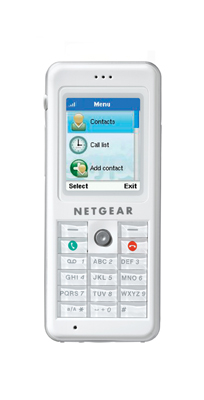
WiFi Skype phone from Netgear

For all you Skypers out there, this could be for you. It's a wireless phone that works independently of a PC to act as a Skype handset.

You can use it home with your wireless network or while out and about on any hotspot or access point (so long as it doesn't require browser-based authentication). No PC required!

It fully integrates with your Skype account, shows and allows you to manage your contacts on its colour screen and is fully compatible with SkypeIn and SkypeOut for making and receiving calls from ordinary non-Skype landlines and mobiles.

Obviously, calling other Skype users is absolutely free!

More info on the Netgear site.

Sunday, 17 September 2006

Microsoft announce Zune - their answer to iPod

So, if you can't beat 'em, copy 'em? That seems to be the premise of Microsoft's full-on foray into the world of digital music.

They criticised Apple's massively successful 'closed' iPod/iTunes/iTunes Music Store ecosystem, then tried and failed to effectively compete with their PlaysForSure concept.

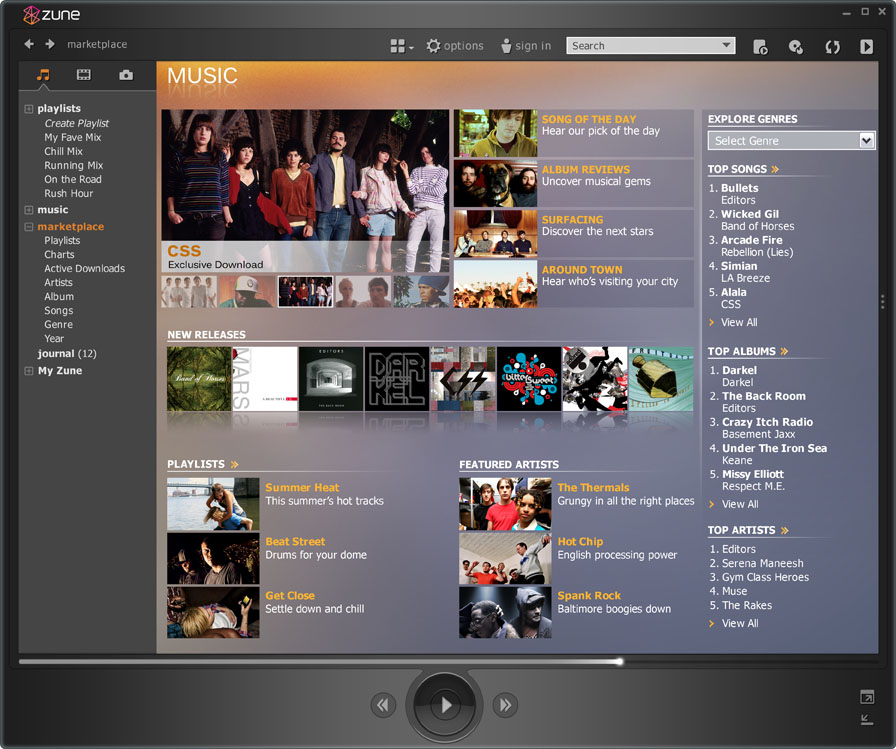
So, now Microsoft have seemingly decided the 'closed' platform that has worked for Apple is the way forward for them as well. Hence, 'Zune' - the new media player/software/online store combination they announced last week.


It works pretty much exactly like the iPod - you buy the Zune player, load the Zune software onto your PC and buy music from the Zune Marketplace (online store). It doesn't work with PlaysForSure or anything else, it only works with itself, just like the iPod.

That is a strange choice for Microsoft. They and their partners have been preaching to us that PlaysForSure is so much better than Apple's iPod world because you can buy any PlaysForSure device from the likes of Samsung, Toshiba, Creative, Philips, Archos etc. and buy music from any PlaysForSure online music store such as MTV's URGE, Napster etc. and they will work together. The perfect antithesis of the iPod world.


Zune flies in the face of PlaysForSure, ignoring the concept of interoperability and puts Microsoft in direct competition with their former partners. Most analysts are predicting that it will be these partners that Microsoft steals market share and sales from - not Apple.

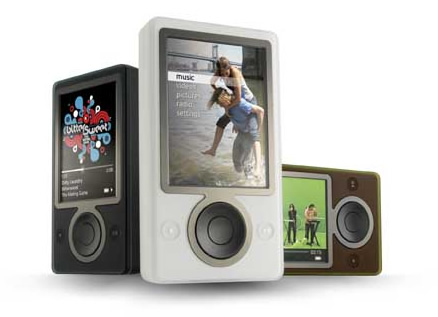
So, what of the new Zune device itself? Well, honestly it seems OK, certainly not groundbreaking and I don't think an iPod killer. Not yet anyway. But it does have a few features the iPod is lacking, for example a 3" widescreen display and wireless song sharing abilities. You can share full-length tracks with other Zune users for up to 3 days or 3 plays, whichever comes first, after which they can flag the song for purchase in the Zune Marketplace. You can also share playlists and photos.

But it's also a fair bit heavier and thicker than the recently updated 30GB iPod and supposedly has slightly less battery life.

The Zune specs look like this:

  • 30GB hard drive
  • QVGA resolution (320 x 240) 3" widescreen display
  • WiFi
  • Supports h.264, MP3, AAC and WMA
  • Built in FM tuner
  • Available in white, black and brown
The two advantages they have over the iPod, the larger screen and WiFi, I expect Apple are already planning on introducing with the 'true' video iPod that has been so anticipated and much rumoured.

I really think if Microsoft want to break the iPod monopoly, they need to make a leap right over Apple and do something new and innovative. Zune is effectively a (poor?) clone of an iPod and that's not going to win them anything. And they certainly can't let Apple beat them on battery life and physical size.

Of course, there has been no mention yet of pricing and with Apple just lowering the price of the 30GB iPod to $249 / £189 Microsoft will find it hard to compete with Apple's massive buying power and economies of scale.

The reaction of prominent bloggers and industry analysts has been muted as well, most seem to be quite skeptical that Microsoft can make a big impact on Apple.

Microsoft are clearly very serious about Zune, are investing a lot in it and have J Allard, the brains behind the Xbox 360, running the program. My feeling is that this is just the beginning of their move into this space. I expect, like Apple, over time they will introduce more devices that compete more fully in all areas and slowly build their platform up.

Overall I think it's a good thing to have a decent level of competition in this industry. It will also bring the best out of Apple and force them to keep innovating, which can only be a good thing for the consumer.