Tuesday, 24 October 2006

Apple introduce Core 2 MacBook Pros

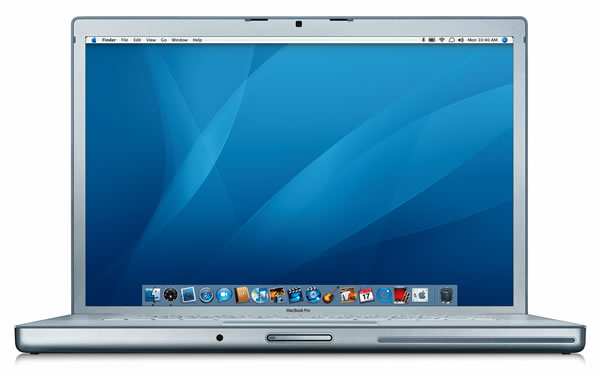
Apple have today announced updates to their flagship MacBook Pro notebooks, now shipping with Intel Core 2 Duo processors in 2.16 or 2.33GHz variants. Apple claim the new machines offer up to 39% better performance than their predecessors.

All of the new MacBook Pro models also now come with double the memory, bigger hard drives, a FireWire 800 port and a dual-layer SuperDrive as standard.

Prices range from £1,349.01 - £1,899.00 in standard configurations. Go see for yourself.


Monday, 23 October 2006

Turn off your gadgets!

This week is energy saving week in the UK and a new report has just been released that shows the UK to be the most wasteful country in Europe. With the average home now having so many consumer electronics, it's no wonder that demand for electricity is so high and wastage so great.

So what are the most wasteful things we do?

  • Leaving our appliances (like that shiny new HD TV you just bought) in standby mode
  • Leaving mobile phone, iPod and other chargers plugged in and turned on when not in use
  • Not switching off lights when not in the room
Leaving devices in standby can account for up to 10% of your energy bill, so knocking that one on the head would be a good start towards saving the planet and your money. For example, I don't watch DVDs that often, so I make sure I turn my DVD player off at the wall when it's not in use and I always turn my TV off at the unit itself, rather than with the remote.

I also make sure that when I'm not actually charging my mobile phone, BlackBerry, iPod or Nintendo DS that the charger unit is turned off at the wall. All the time that a charger is plugged in and turned on it is using a few watts of electricity, even when it's not charging anything!

Finally, leaving your computer and ADSL modem or router running all the time will use huge amounts of electricity. I have set my iMac's display to turn off after 5 minutes and it will enter sleep mode after 15 minutes of inactivity. Ideally, I try and turn it fully off whenever I can and particularly if I am going to be away for a few days. I also turn my wireless ADSL router off every night and only turn it back on again when I next need to use it.

And leaving the lights on when not in the room? That's just silly. It's like leaving the front door open when you go out. And you are using energy saving light bulbs, right? Please say yes, a single energy saving bulb will save you around £9 on your annual electricity bill and up to £100 over its lifetime.

Oh and one last thing - remember, if you're boiling the kettle, only fill it with as much water as you need for your cup of tea, not all the way to the top!

For more tips on energy saving check out the Energy Saving Trust's website.


Monday, 16 October 2006

Blu-ray becomes a reality in the UK

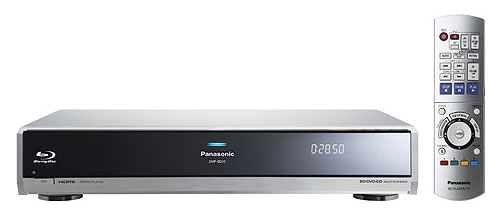
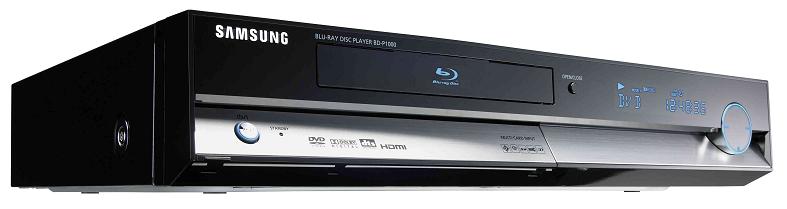
The HD war comes to the UK this week with the launch of the first Blu-ray players. The Panasonic DMP-BD10 and the Samsung BD-P1000 are both state-of-the-art offering 1080p output, perfect for one of those 1080p TVs you've been eyeing recently.


They're pretty pricey mind you, at around £1000 for the Panasonic and £800 for the Samsung. The DMP-BD10 paired with Panasonic's matching SA-XR700 AV Receiver and a Viera plasma would be a stunning combination though, even if it did set you back the best part of 3 or 4 thousand pounds.

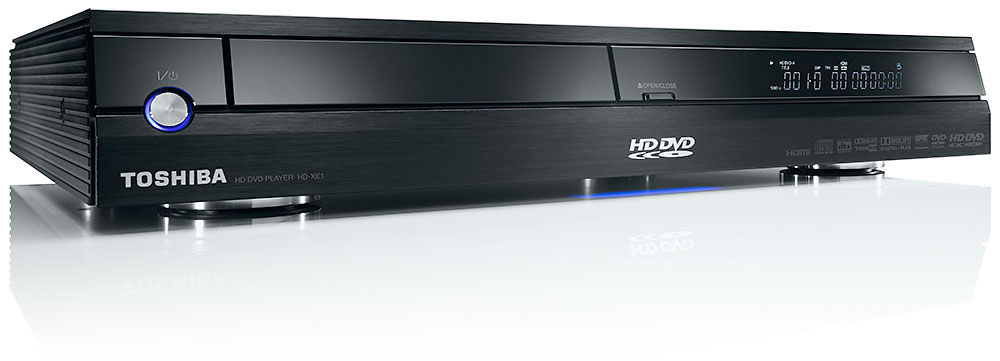
The retaliation comes next month with Toshiba launching their HD-XE1 and HD-E1 HD DVD players, with the E1 half the price of the Panasonic Blu-ray player and the high-spec XE1 still several hundred pounds cheaper, it should make for some interesting competition.

So, let the battle commence. But unless you have a lot of money to throw around, you may just want to hold back, watch them fight it out and wait for prices to come down before you decide who to pledge your allegiance to.

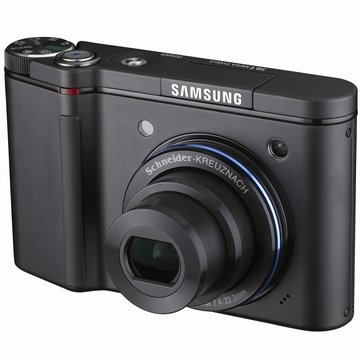
Samsung NV10 - point and shoot impressions


Samsung NV10

-10.1 Megapixels
-3x Optical Zoom
-Advanced Shake Reduction (ASR)
-“Smart Touch” User Interface
-Large 2.5" TFT LCD
-ISO 1000

Over the weekend, I got to put the NV10 through its paces a little, I say a little because I didn't use it as anything more than a put-it-in-your-pocket snapper.

I had fairly high hopes for this little fella, I like the retro black look and the hookup to my Mac was as usual, a piece of cake.

However for a 10.1 megapixel camera I hoped for more and those hopes were mostly dashed.

The unit is small and light, but the screen's prone to scratching, the USB cable that plugs in and acts as a charger too, means you can't stand the camera up whilst connecting it to your computer, which means it lays on its screen or face -neither being ideal.

The back is lined with a series of touch sensitive, contextual buttons. It takes a bit of getting used to, but it does work. Not great if, like me, you choose your settings as you go, lining up a shot then needing both hands to operate the touch sensitive buttons on the back.

The macro mode is good, but didn't seem as good as the Sony T10 I used recently. The resulting images are ok, but again, I've been more impressed with my rather old (if now broken) Sony P10.

The camera responds quickly, the burst modes and video modes work well, time between shots seems fast and initial switch on to picture taking was acceptable - but overall I was disappointed.

The unit's realtively cheap to buy, about £225 on-line. And for that sort of money maybe I'm being too harsh. However, I thought that image quality was lacking, colours seemed quite dull and the heralded ASR (anti-shake to help with your images) wasn't that great either.

I've not gone through the unit exhaustively, in fact I've used it as I would any easy to pick up point and shoot. But in those circumstances, my 4-year old Sony P10 did a better job, albeit slower and more chunky.

Friday, 13 October 2006

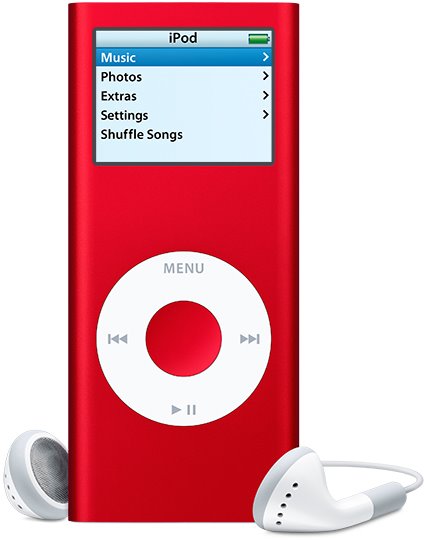
iPod nano (PRODUCT) RED Special Edition

Apple have today announced a special addition (PRODUCT) RED 4GB iPod nano. It's exactly the same as a normal 4GB iPod nano except for 2 things - it's red and Apple will give $10 of its purchase price to the Global Fund to fight AIDS in Africa.

Apple joins Motorola, GAP, Armani, Converse and American Express in offering RED products and as they say, it means your iPod nano (PRODUCT) RED sounds good and does good at the same time.

For more info on (PRODUCT) RED visit their website at http://www.joinred.com/


Wednesday, 11 October 2006

Google combine online Docs and Spreadsheets

Not content with their attempted domination of online video with their recent acquisition of YouTube, Google have today announced that they are effectively going after Microsoft Office by offering an integrated, online word processing and spreadsheets application - Google Docs & Spreadsheets.

Google spreadsheets has been around for a few months and Google purchased Writely, an online word processing app, back in March. Now they have combined the two to provide an integrated online file creation solution.

I've been using their spreadsheet app for a while and it's great. I'm now looking forward to getting to grips with the docs app.

Maybe I won't need to buy the new version of Microsoft Office next year afterall? That's what Microsoft must now be afraid of.

See it here: http://docs.google.com/


Tuesday, 3 October 2006

Free TomTom Traffic Updates, sort of.

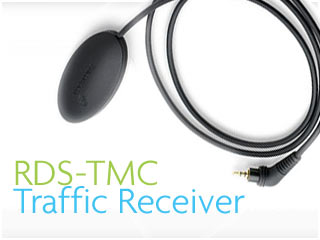
How about not paying a yearly subscription for TomTom traffic and instead being able to use the over the air RDS-TMC traffic info instead? Any lucky 'GO' users out there can make the one off payment for the RDS-TMC Traffic receiver and make use of the free service to replot and avoid traffic incidents.

So what are the differences in terms of the service? Well, the RDS-TMC is going to require fm radio signal and a source that provides the information, this is obviously going to vary location by location, versus the GPRS on-demand nature of the TomTom Plus traffic system. The RDS-TMC wont work on every TomTom device, so 'ONE' users like myself will not have this option. Also the RDS-TMC has a limited number of messages, so its likely that the more expensive (in the long term) TomTom Plus service is more suitable if you must have the latest, most detailed traffic info.

At around £68 its not bad value, depending on how well it performs in the field. Of course you do have yet another attachment (the RDS-TMC Traffic receiver) to take with you, versus the omni-present mobile phone which connects you to the TomTom Plus service.

You can check it out on the TomTom UK website here or google it to your heart's content.

I would be remiss if I didn't chuck in a quick mention to any TomTom owners, mac or pc, who dont have the rather good TomTom Home software, for managing their beloved device. When I bought my 'ONE' it didn't have any mac software available, now it does. Recently installing it and allowing it to update my TomTom firmware gave 'Jane' a very nice face-lift. All gradients everywhere and some improved/re-vamped icons. Added functionality included the ability to navigate to Latitude and Longditude also the arrive by time function - where you can put in a time which you wish to arrive by when you plan your route. TomTom Home can be downloaded from this page on the UK site.

Monday, 2 October 2006

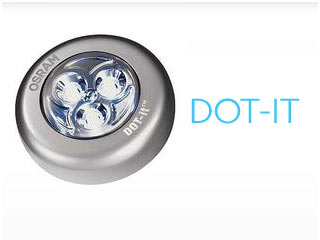
Dot-it, anywhere?


During SCB's absence I've promised to post more often, of course I promise to do this when he's around too so its a fairly empty promise. With that said though, I did just spot these, are they gadgets well, sort of.

They're cheap LED stick-anywhere lights called Dot-It. 100 hours of replaceable battery-life for about 8quid a pop. Personally I can think of a variety of places these could come in handy, under kitchen-cabinet lighting, illuminated wardrobes but I intend to put a couple in my garden shed - until I get some power wired in there.

In the UK they're made by OSRAM, various others in different regions - all essentially the same, you remove the adhesive label and stick em up, press to turn on and off and relocate at will. I've ordered a few so I'll let you know how they go.

I just bought mine from here but there are others out ther too.

Thursday, 28 September 2006

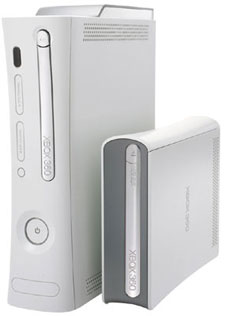
Xbox 360 HD DVD add-on coming to UK

Microsoft have announced that the HD DVD add-on for the Xbox 360 is coming to the UK, North America, France and Germany in "mid-November" priced at £129.99 / $199.99 / €199.99.

The player comes with Peter Jackson's "King Kong" on HD DVD (for a limited time) and is bundled with the Xbox 360 Universal Media Remote.

So, you can just add the HD DVD player to your Xbox 360 to get a cheap, next generation, high definition movie set-up.

They've priced it carefully so that when you buy a 360 and the add-on player, it equates to the same price as a PS3, which of course comes with Blu-ray.


Touché.

Tuesday, 26 September 2006

Compact digital camera roundup

People ask me all the time "Which camera should I buy?", by which they are normally referring to a point and shoot digital compact.

Over the summer there have been new compacts announced by pretty much all of the major manufacturers, so here's a summary of some of the best and a quick feature comparison.

I hasten to add, I haven't used any of these cameras, so make sure you read some proper reviews before making any purchasing decisions!

I've selected the newest, most comparable offerings from each manufacturer, so these are really the high-end of the ultra-compacts with the latest features, not your budget cameras.

So, here they are, in alphabetical order:

Canon Digital IXUS 850 IS
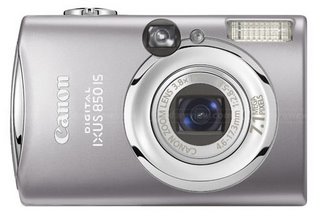

  • 7.1 megapixels
  • 2.5" LCD
  • 25.1mm thick
  • 640 x 480 @ 30 / 15fps movie mode
  • ISO 1600
  • 3.8x optical zoom
  • Face Detection / 9-point focus
  • SD / SDHC / MMC memory cards
  • Optical image stabilisation
  • Approx. 270 shots on one charge

Casio EXILIM Card EX S-770
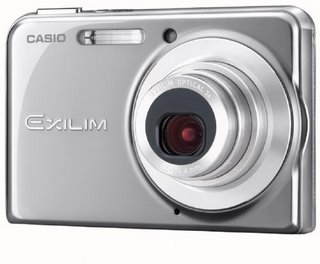

  • 7.2 megapixels
  • 2.8" widescreen LCD
  • 17.3mm thick
  • 704 x 384 (Wide), 640 x 480 movie mode
  • ISO 800 (Anti Shake or High Sensitivity modes)
  • 3x optical zoom
  • 9 point multi focus
  • SD / SDHC / MMC memory cards
  • Anti-shake DSP
  • Approx. 200 shots on one charge

Nikon Coolpix S7c
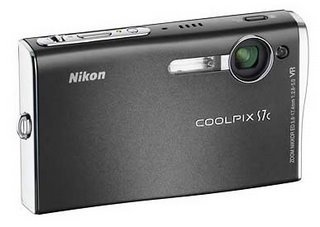

  • 7.1 megapixels
  • 3.0" LCD
  • 21mm thick
  • 640 x 480 @ 30fps movie mode
  • ISO 1600
  • 3x optical zoom
  • Face-priority AF focus
  • SD memory cards
  • Vibration Reduction
  • WiFi connection
  • Approx. 200 shots on one charge

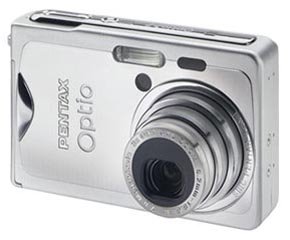
Pentax Optio S7


  • 7.0 megapixels
  • 2.5" LCD
  • 19.5mm thick
  • 640 x 480 @ 30 fps (DiVX) movie mode
  • ISO 400 (800/1600 at 4 MP)
  • 3x optical zoom
  • 5-point multi focus
  • SD / SDHC / MMC memory cards
  • Blur reduction mode
  • Approx. 180 shots on one charge

Sony CyberShot DSC-T10
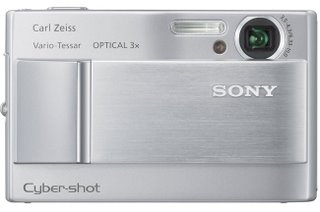

  • 7.2 megapixels
  • 2.5" LCD
  • 20.6 thick
  • 640 x 480 @ 30fps movie mode
  • ISO 1000
  • 3x optical zoom
  • 5-point multi focus
  • Memory Stick Duo™ / Memory Stick Duo™ Pro memory cards
  • Optical image stabilisation
  • Approx. 250 shots on one charge

Comparison table

(click image for large, readable version!)


So, all of the cameras have about the same resolution sensors; similar sized, decently large screens; similar movie modes and at least some kind of anti-shake or blur reduction.

I think table shows that spec-wise the Canon is the leader with it's high ISO 1600 sensitivity, optical image stabilisation, 3.8x zoom, face detection auto-focus and 270 shots on one charge. However, it does sacrifice on it's size and weight and is the most chunky of the 5.

The smallest is the Casio at just 17mm thick, nearly 8mm thinner than the Canon, while still managing to pack a 2.8" 16:9 display (the only widescreen display amongst this bunch), a 3x zoom, the same resolution and good battery life. It also has a widescreen movie recording mode. Very impressive and if having the most ultra-compact camera is what you're after, this is the one.

The Nikon has the largest screen at 3" and is the only camera here with WiFi for transferring images to your computer or printer wirelessly (although that may be frustratingly slow when downloading a whole memory card). It also has the same high ISO 1600 sensitivity and face recognition auto-focus as the Canon but it is also the second thickest after the Canon and doesn't support the new SDHC memory card format.

The Pentax doesn't really best any of the others in any category but it isn't too far off in most areas. It's the second thinnest after the Casio but it has the worst battery life at only 180 shots and only manages 4 megapixels at it's high sensitivity setting (7 megapixels normally). Otherwise, it's pretty much in line with the others with the 2.5" LCD, 3x zoom and 640 x 480 30fps movie mode.

Finally, the Sony is similar to the Pentax but slightly thicker, it does though have the second best battery life and is the only one here, other than the Canon, to have proper optical image stabilisation. But one of my pet hates about Sony is their insistence on using their own memory card format. All the other cameras here use SD but the Sony uses Memory Stick Duo, so if you already have SD cards, you're going to have to buy all new Memory Stick Duo cards to use the Sony.

So, which one would I buy? In the absence of hands-on reviews, judging purely on the specs and what I know of previous cameras from these manufacturers, I would say if you don't mind the extra bit of bulk, the Canon will probably take the best pictures but if smaller is better, then the Casio could well be the one. I would also consider the Nikon as it's possibly the best all round compromise between features and size.

I definitely recommend you try and find some decent reviews of these cameras before buying one though and as always, go into Jessops or something, have a look and try them out as well.

dpreview.com is always a good place to find excellent reviews.